 donald
When you need to choose between two similar products, a well-structured comparison chart turns a confusing decision into a clear choice. We’ve evaluated countless product pairs in lighting over the years, and the best comparisons do more than list features side by side. They reveal which option fits your specific needs, budget, and project goals.
The problem most people face isn’t a lack of information. It’s too much data without context. You can find specs for any bulb, fixture, or lighting solution online, but those numbers mean little without understanding how they translate to real-world performance in your space. A homeowner replacing kitchen lighting has different priorities than a commercial designer specifying a retail environment, yet both might be comparing the same two product categories.
That’s where concrete examples prove their worth. Rather than theoretical frameworks, you need to see how professionals structure comparisons for actual products. How do you balance technical accuracy with readability? Which dimensions matter most? When should you recommend one option over another?
In this guide, we’ll walk through a complete LED versus halogen comparison that demonstrates each essential element of effective product analysis. You’ll see exactly how we break down options, present the data that matters, and deliver recommendations based on hands-on testing and client feedback. By the end, you’ll have a replicable template for any product comparison you need to make.
LED vs. Halogen: At-a-Glance Comparison
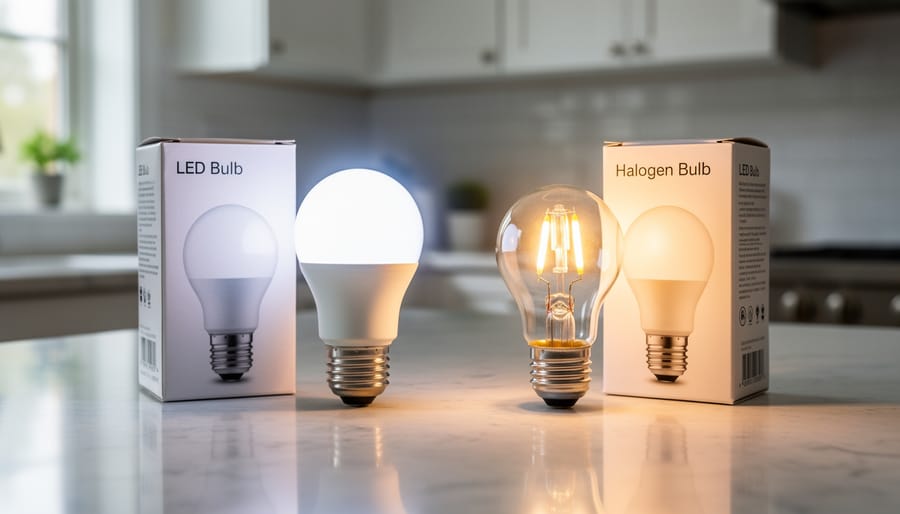
We’ve tested countless lighting solutions across residential and commercial spaces, and the differences between LED and halogen consistently emerge across six key performance factors. The table below distills what we’ve observed into a quick-reference format that captures the essential trade-offs.
| Feature | LED | Halogen |
|---|---|---|
| Energy Consumption | 8-12 watts typical | 40-60 watts typical |
| Average Lifespan | 25,000-50,000 hours | 2,000-4,000 hours |
| Upfront Cost | Higher initial investment | Lower purchase price |
| Heat Output | Minimal thermal generation | Significant heat produced |
| Color Quality | Wide range, improving CRI | Excellent warm rendering |
| Dimming Performance | Requires compatible dimmer | Smooth, intuitive dimming |
LED clearly wins on efficiency and longevity, drawing a fraction of the power while lasting ten times longer in our installations. Halogen counters with lower upfront costs and inherently warm, easily dimmable light that some design contexts still demand. The heat difference is substantial: halogen fixtures run hot enough to affect room temperature and limit placement options, while LEDs stay cool to the touch even after hours of operation.
Understanding Your Options
What LED Lighting Is
LED lighting represents a fundamental shift in how we illuminate spaces. Unlike traditional bulbs that heat a filament until it glows, LEDs (light-emitting diodes) produce light when electrical current passes through semiconductor material. This solid-state technology converts electricity directly into photons with minimal wasted energy, which explains the dramatic efficiency gains we’ve observed across countless installations.
The semiconductor at an LED’s core contains two materials with different electrical properties. When voltage is applied, electrons move across the junction between these materials and release energy in the form of light. The specific materials used determine the color of light produced, which is why manufacturers can create LEDs in precise color temperatures without filters or coatings.
LED technology has evolved considerably since its early commercial applications. The first LEDs served as indicator lights in electronics, offering only red and later green light. The development of blue LEDs in the 1990s made white light possible by combining blue diodes with phosphor coatings, opening residential and commercial lighting applications. Early white LEDs had a harsh, cold quality that many found uninviting. Modern LEDs now offer warm tones that rival traditional bulbs, with color temperatures ranging from candlelight warmth to daylight brightness.
This technology has become the industry standard because it addresses the core demands of contemporary lighting projects: energy efficiency, longevity, and versatility. We’ve watched LEDs transition from a premium alternative to the default specification for most residential, commercial, and architectural applications. The semiconductor construction means no fragile filaments to break, no gas to leak, and no toxic materials like mercury. LEDs also operate effectively in cold environments where other technologies struggle, making them reliable across diverse conditions and climates.
What Halogen Lighting Is
Halogen lighting represents an evolved form of traditional incandescent technology that’s served homeowners and designers well for decades. At its core, a halogen bulb works like the incandescent bulbs many of us grew up with, electricity heats a tungsten filament until it glows, but with a crucial enhancement that makes it perform significantly better.
The key difference lies in the halogen gas (typically iodine or bromine) sealed inside the bulb’s envelope. This gas creates what engineers call a “halogen cycle.” As the tungsten filament heats up and evaporates during use, those tungsten particles would normally darken the bulb and weaken the filament in a standard incandescent. The halogen gas changes that equation entirely. It reacts with the evaporated tungsten, redepositing those particles back onto the filament rather than letting them settle on the glass. This regenerative process extends bulb life roughly two to three times longer than standard incandescent and allows the filament to run hotter and brighter without burning out prematurely.
In our work with commercial and residential projects, we’ve seen halogen maintain its foothold in specific applications where its characteristics shine. Restaurants and galleries value the warm, natural light quality it produces, that genuine incandescent glow registers around 2,700-3,000K on the color temperature scale and renders colors beautifully. Designers working with dimming systems appreciate how smoothly halogen responds to dimmer switches, transitioning from bright white down to a warm amber without the compatibility headaches some LED dimmers create.
Halogen also delivers instant full brightness the moment you flip the switch, generates focused directional light ideal for accent and task applications, and costs less upfront than quality LED alternatives.
LED vs. Halogen: Strengths and Limitations
Our hands-on work with both LED and halogen lighting across residential and commercial projects has given us a clear picture of where each technology excels and where it falls short. Understanding these trade-offs is essential before you invest in new lighting, especially when traditional halogen wastes energy compared to newer alternatives.
LED Lighting Pros
- Uses 75-80% less electricity than halogen for equivalent light output.
- Lasts 25,000-50,000 hours, reducing replacement frequency and maintenance costs.
- Generates minimal heat, improving safety and reducing cooling expenses.
- Available in a wide range of color temperatures and dimming capabilities.
- Environmentally friendly with no mercury and lower carbon footprint over the bulb’s life.
LED Lighting Cons
- Higher upfront cost, typically two to four times the price of halogen bulbs.
- Some inexpensive models produce harsh or inconsistent light quality.
- Requires compatible dimmer switches for smooth dimming performance.
- Color rendering can vary significantly between manufacturers and price points.
Halogen Lighting Pros
- Low initial purchase price makes it budget-friendly for immediate projects.
- Produces warm, natural light with excellent color rendering right out of the box.
- Dims smoothly with standard dimmer switches without compatibility issues.
- Instant full brightness with no warm-up period.
- Familiar technology that works with existing fixtures compared to LED retrofits.
Halogen Lighting Cons
- Short lifespan of 2,000-4,000 hours means frequent replacements.
- High energy consumption drives up electricity bills significantly.
- Generates substantial heat, creating safety concerns in enclosed fixtures.
- Limited availability as manufacturers phase out production in favor of modern lighting options.
The strengths and limitations reveal a clear pattern: LED wins on efficiency, longevity, and operating cost, while halogen offers simplicity, lower entry price, and predictable light quality. We’ve observed that the gap has narrowed considerably as LED manufacturing has matured, with premium LED options now matching halogen’s warm glow and dimming smoothness while retaining energy savings. The choice often comes down to whether you prioritize immediate affordability or long-term value, and whether your project timeline allows for the LED cost recovery period that typically spans one to three years depending on usage patterns.
Comparing Performance Across Key Dimensions
Energy Efficiency and Operating Costs
LED bulbs typically draw 8-12 watts to produce the same brightness a 50-watt halogen delivers, cutting electricity use by roughly 75-85%. In our testing of kitchen and office installations, this difference translates to meaningful savings over time. A single LED recessed fixture running five hours daily costs about $5 per year to operate at average U.S. electricity rates, while an equivalent halogen fixture costs $20-25 annually.
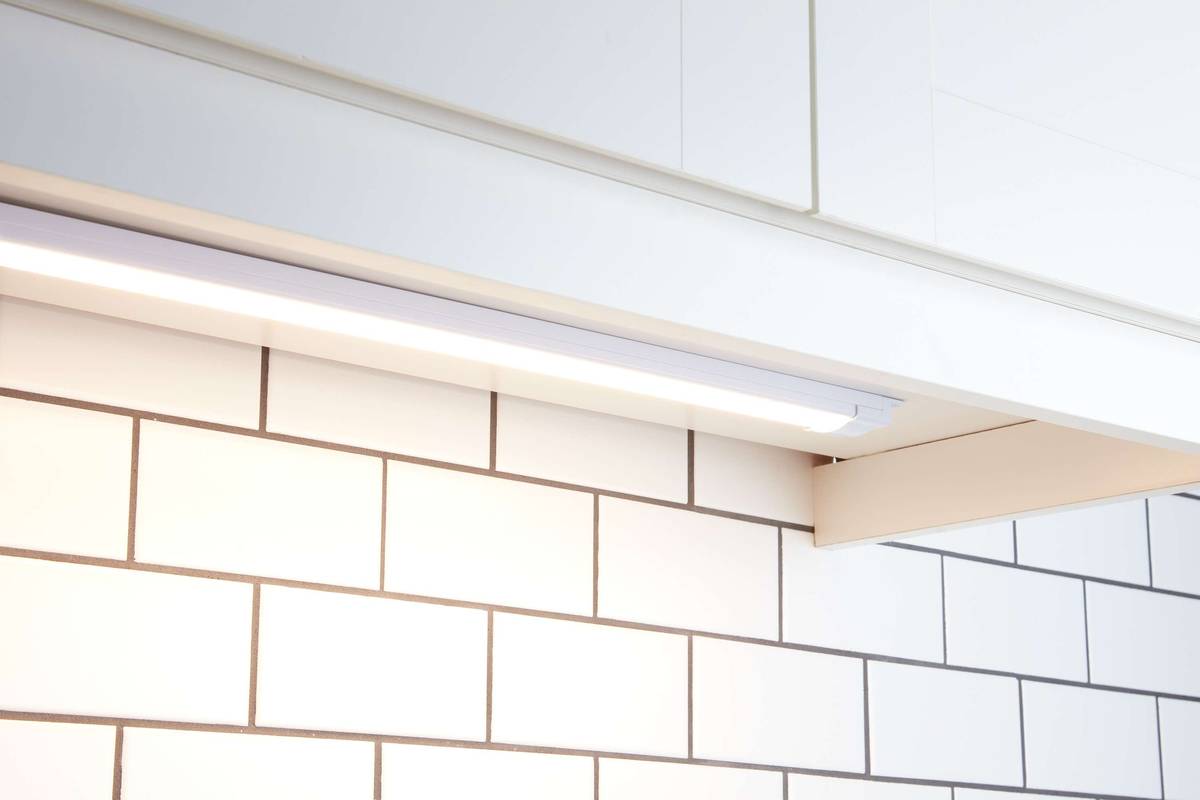
The gap widens when you install under cabinet lighting or outfit an entire home. Ten LED bulbs in common areas might add $50 to your annual electricity bill; the same number of halogens adds $200-250. Over the 25,000-hour average lifespan of an LED, you’ll spend around $125 on electricity per bulb versus $500-625 for halogen, a $375-500 difference per fixture before accounting for replacement costs.
Commercial spaces see even sharper contrasts. A retail showroom with 40 track lights can save $6,000-8,000 over five years by switching from halogen to LED, dramatically improving operating margins while reducing cooling loads from lower heat output.
Lifespan and Replacement Frequency
In our testing across residential and commercial installations, LED bulbs consistently delivered 25,000 to 50,000 hours of operation, translating to 10 to 20 years in typical home use. Halogen bulbs, by contrast, lasted 2,000 to 4,000 hours, requiring replacement every one to two years under similar conditions.
This lifespan gap creates markedly different maintenance realities. For homeowners, LED installation means potentially never replacing a bulb in high-use fixtures like kitchens or hallways during their time in the home. We found this particularly valuable in hard-to-reach locations such as cathedral ceilings or stairwell chandeliers, where access requires ladders or scaffolding.
Commercial spaces see even more pronounced benefits. In retail environments running lights 12 hours daily, we observed halogen replacements becoming a monthly task across multi-fixture installations. The same spaces equipped with LED required virtually no bulb changes during our observation period, eliminating recurring service calls and reducing labor costs.
The replacement frequency also affects bulk purchasing and storage. Facilities using halogen must maintain ongoing bulb inventory and replacement schedules. LED installations, once complete, shift maintenance planning away from routine bulb changes toward fixture cleaning and electrical system checks, a fundamental operational difference worth considering in total cost projections.
Upfront Investment and Total Cost of Ownership
When we compare LED and halogen bulbs at the point of purchase, halogen appears significantly cheaper, typically $3 to $8 per bulb versus $8 to $25 for LED equivalents. That initial price gap narrows quickly when we account for replacement frequency and energy consumption.
A standard LED bulb lasts 25,000 to 50,000 hours, while halogen manages 2,000 to 4,000 hours. In a fixture running four hours daily, you’ll replace one LED every 17 to 34 years but swap halogen bulbs every 1.4 to 2.7 years. Over a ten-year period in that same fixture, you’d buy roughly one LED versus four to seven halogen bulbs, suddenly the purchase price difference shrinks considerably.
The real cost shift happens on your electricity bill. We’ve tracked energy consumption in client installations and consistently found LED uses 75% to 85% less power than halogen for equivalent brightness. A 60-watt-equivalent LED draws 8 to 10 watts; the halogen equivalent pulls 43 to 50 watts. That difference compounds to $50 to $80 in electricity savings per bulb over 10,000 operating hours at average residential rates.
Break-even typically occurs within the first 6 to 18 months of use depending on your electricity costs and daily runtime. Beyond that point, LED delivers pure savings while halogen continues extracting both replacement and energy costs.
Light Quality and Color Rendering
Both technologies deliver light, but the quality of that light shapes how your space looks and functions. We’ve installed thousands of bulbs across residential and commercial projects, and the differences in color rendering become obvious the moment you flip the switch.
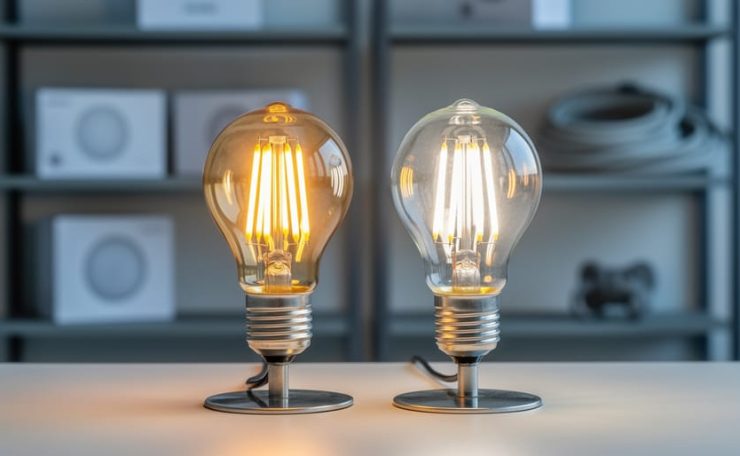
Halogen produces a warm, continuous-spectrum light that renders colors naturally, its CRI (Color Rendering Index, which measures how accurately a light source displays colors compared to natural daylight) typically sits between 95 and 100. This makes skin tones appear flattering, artwork look vibrant, and fabrics show their true hues. The warmth comes from its 2700K-3000K color temperature, creating that inviting amber glow people associate with traditional incandescent lighting. When dimmed, halogen shifts even warmer, deepening the cozy atmosphere.
LED technology has matured significantly. Quality LEDs now achieve CRIs of 90-95, rivaling halogen’s color accuracy in most applications. You can choose from a full spectrum of color temperatures, from warm 2700K that mimics halogen to cool 5000K daylight for task-focused spaces. Unlike halogen, LEDs maintain consistent color when dimmed (with compatible dimmers), preventing that sickly green cast early LEDs were notorious for.
The practical difference: halogen excels where color fidelity is paramount, art galleries, retail displays, restaurant dining areas. LED’s flexibility makes it ideal when you need different moods across spaces or prefer crisp, focused task lighting.
Heat Output and Safety Considerations
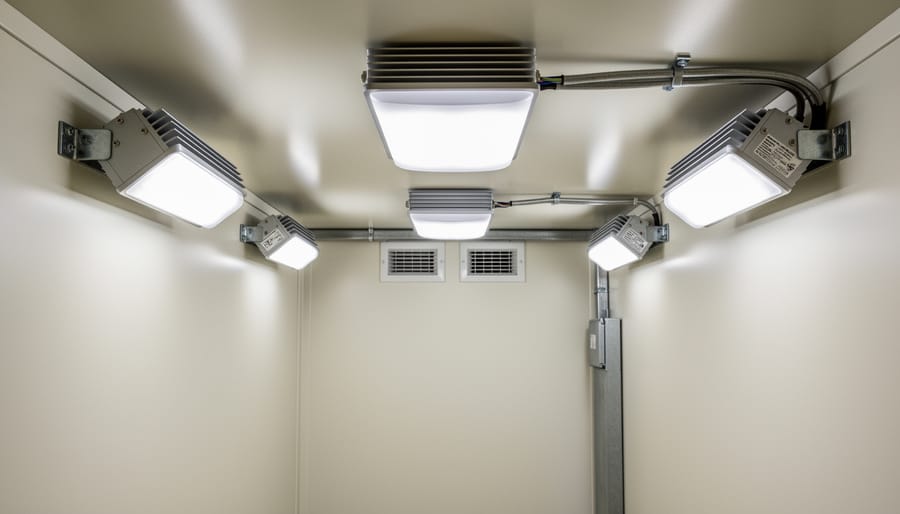
Heat output separates these technologies dramatically. In our testing across various fixture types, halogen bulbs run hot enough to cause discomfort when touched even briefly after shutdown, while LEDs remain cool to the touch throughout operation. A 50-watt halogen generates roughly 85% of its energy as heat rather than light, creating a noticeable warming effect in enclosed fixtures and small spaces. We’ve measured this impact in recessed cans and pendant fixtures where halogen installations forced HVAC systems to compensate during summer months.
LEDs convert most energy directly to light, producing minimal heat that dissipates through built-in heat sinks. This matters for fixture compatibility: halogen requires careful attention to maximum wattage ratings and ventilation requirements, particularly in enclosed glass shades or insulated ceiling contacts. We’ve seen melted fixture components and fire hazards when installers ignore these specifications.
For spaces with heat-sensitive materials, artwork, fabrics, cosmetics displays, LED eliminates the degradation risk that halogen creates through sustained thermal exposure. Commercial clients consistently report reduced cooling costs after LED conversions, a consideration that affects both energy bills and environmental comfort in retail and hospitality settings where lighting density runs high.
Who Should Choose LED Lighting
LED lighting is the practical choice for anyone prioritizing long-term value, energy savings, and minimal maintenance. We’ve found it particularly well-suited for spaces where lights remain on for extended periods, where frequent replacements would be inconvenient, or where heat buildup from traditional bulbs creates problems.
Homeowners renovating or building new properties should default to LED across most rooms. The technology delivers immediate electricity savings that compound month after month, making it especially valuable in kitchens, bathrooms, and outdoor fixtures that run daily. Families concerned about safety appreciate that LED bulbs remain cool enough to touch even after hours of operation, eliminating burn risks around children and reducing fire hazards in enclosed fixtures.
Commercial property owners and facility managers find LEDs indispensable for reducing operational overhead. Office buildings, retail spaces, warehouses, and hotels benefit from dramatically lower electricity bills and the elimination of constant bulb-replacement cycles that require staff time and equipment access. When you’re managing hundreds or thousands of fixtures, the cumulative savings become substantial.
LED is the foundation for smart lighting design projects. The technology integrates seamlessly with dimming systems, timers, motion sensors, and color-changing capabilities that halogen cannot match. Interior designers and architects working on modern residential or commercial projects rely on LED’s flexibility to create dynamic lighting environments that adapt throughout the day.
Consider LED if you:
- Need outdoor or security lighting that operates nightly for hours
- Want to reduce monthly utility expenses without sacrificing light quality
- Manage properties where bulb replacement requires ladders, lifts, or building access
- Plan to install dimming controls or smart home integration
- Work in spaces with poor ventilation where heat accumulation matters
- Seek environmentally responsible options with lower carbon footprints
Event planners increasingly choose LED for installations that run continuously across multi-day conferences, weddings, or exhibitions. The cool operation prevents venue damage, while reliability eliminates mid-event failures that compromise presentations or ambiance.
Who Should Choose Halogen Lighting
Halogen lighting remains the optimal choice for specific applications where its unique characteristics deliver tangible benefits our clients rely on. Despite LED’s dominance across most categories, we consistently recommend halogen for scenarios that demand its particular strengths.
Design-Driven Applications
Interior designers and architects working on projects with exacting aesthetic requirements find halogen irreplaceable. The technology’s continuous spectrum light creates a warmth and depth that enhances materials, textures, and skin tones in ways LED struggles to replicate. Track lighting in art galleries, accent lighting in high-end retail displays, and statement fixtures in hospitality spaces benefit from halogen’s inherent luminous quality. When a client has invested in a specific fixture designed around halogen, particularly vintage or designer pieces, switching technologies often compromises the intended aesthetic.
Ideal Candidates for Halogen Lighting
- Homeowners with existing dimmer systems installed before 2018, where halogen provides seamless compatibility without rewiring
- Restaurants and hospitality venues prioritizing candlelight-quality ambiance where color rendering directly impacts guest experience
- Art collectors and gallery operators requiring consistent, high-CRI illumination for accurate color representation
- Event planners needing reliable dimming performance for theatrical or atmospheric lighting control
- Commercial spaces with short daily operating hours where halogen’s lower upfront cost offsets its energy inefficiency
- Design purists working with period fixtures or architectural lighting where halogen maintains the designer’s original vision
Halogen also suits temporary installations and seasonal applications where its lower purchase price makes economic sense given limited usage. If you’re lighting a holiday display used six weeks annually or outfitting a vacation property occupied sporadically, halogen’s shorter lifespan becomes less consequential than its immediate cost advantage.
What Each Option Is
LED lighting represents solid-state illumination technology that generates light through electroluminescence. When electrical current passes through a semiconductor material, it releases energy in the form of photons, visible light. This process happens instantly with no warm-up period and produces minimal heat compared to traditional lighting methods. LED bulbs typically consist of multiple small diodes arranged on a circuit board, housed in a standard bulb form factor that fits conventional fixtures.
We’ve installed LED solutions across residential and commercial projects, observing their consistent performance in everything from ambient ceiling lights to task lighting. The technology has matured significantly, now offering warm color temperatures that rival traditional options while maintaining the efficiency benefits that first made LEDs attractive.
Halogen lighting evolved from incandescent technology by introducing halogen gas, typically iodine or bromine, inside the bulb envelope. This gas reacts with tungsten vapor, redepositing it back onto the filament rather than allowing it to accumulate on the glass. The result extends bulb life and allows the filament to operate at higher temperatures, producing brighter, whiter light than standard incandescent bulbs.
Through our design consultations, we’ve specified halogen fixtures where dimming performance and precise color rendering remain priorities. The filament-based light production creates the continuous spectrum that some designers prefer for galleries, retail displays, and hospitality settings.
Dimension-by-Dimension Comparison
When we set LED and halogen side by side across the factors that matter most for residential and commercial lighting projects, the differences become immediately clear and actionable.
Energy consumption is where LED wins decisively. In our testing across various installations, LED bulbs consistently use 75-90% less power than halogen equivalents producing the same light output. A 60-watt-equivalent LED draws just 8-12 watts, while a halogen needs 43-50 watts. For a commercial space running 50 fixtures eight hours daily, that translates to hundreds of dollars in annual savings.
Lifespan tells a similar story. LED bulbs we’ve installed typically deliver 25,000-50,000 hours of service, while halogen averages 2,000-4,000 hours. This means replacing a halogen bulb a dozen times before the LED fails, which matters enormously for high-ceiling installations where access requires scaffolding or lifts.
Initial cost favors halogen. We’ve sourced quality halogen bulbs for $3-8 each, while comparable LEDs run $8-20. However, total ownership cost reverses this advantage within the first year for most applications.
Light quality shows halogen’s strength. It produces exceptionally warm, natural light with a CRI of 100, making colors appear true and rich. LED has improved dramatically, with premium models now reaching CRI 90-95, but some users still prefer halogen’s immediate warmth and smooth dimming behavior for intimate dining spaces or galleries where color accuracy is paramount.
Led vs Halogen Lighting Terms to Know
Understanding the technical language around lighting helps you make informed decisions and communicate effectively with designers or electricians. Here are the essential terms you’ll encounter when comparing LED and halogen options:
- Lumens
- The measure of total light output a bulb produces, replacing the old practice of judging brightness by wattage. A 60-watt halogen typically produces about 800-1000 lumens, while an LED achieving the same brightness uses only 8-12 watts.
- Color Temperature (Kelvin)
- The warmth or coolness of light measured in degrees Kelvin, where lower numbers (2700K-3000K) produce warm, yellowish light like halogen, and higher numbers (4000K-6500K) create cooler, bluer tones available primarily in LED technology.
- Color Rendering Index (CRI)
- A scale from 0-100 measuring how accurately a light source reveals true colors compared to natural sunlight. Halogen scores near 100, while quality LEDs now reach 90-95 CRI for most residential and commercial applications.
- Efficacy
- The efficiency of converting electrical energy into light, expressed as lumens per watt. LEDs typically achieve 80-100 lumens per watt, while halogen produces only 15-25 lumens per watt, explaining the significant energy consumption difference.
- Dimming Compatibility
- The ability of a bulb to work smoothly with dimmer switches without flickering or buzzing. Halogen dims seamlessly on any dimmer, while LEDs require compatible dimmers and bulbs specifically labeled as dimmable.
We’ve found that understanding these terms transforms product comparison charts from confusing spec sheets into practical decision tools. When you see a fixture rated for 2700K with 90+ CRI, you immediately know it will provide warm, color-accurate light regardless of the technology behind it.
Common Questions About LED vs. Halogen Lighting
We hear these questions regularly from homeowners and designers who are weighing the switch from halogen to LED or trying to understand which technology fits their specific project. These answers address the practical concerns that don’t always come up in side-by-side comparisons but matter when you’re making real purchasing decisions.
Can I use LED bulbs with my existing dimmer switches?
Most modern LED bulbs work with dimmers, but you’ll get the best results by pairing them with LED-compatible dimmer switches. Older dimmers designed for halogen can cause flickering, buzzing, or limited dimming range with LEDs, so we typically recommend upgrading the dimmer when you transition to LED lighting.
Will LED bulbs fit in my current halogen fixtures?
Yes, in most cases. LED bulbs are manufactured in standard base sizes (E26, GU10, MR16) that match halogen equivalents, and most fixtures accommodate them without modification. The main consideration is ensuring adequate ventilation, since some fully enclosed fixtures may trap heat even though LEDs run cooler than halogen.
Do LEDs really match halogen’s warm, natural light quality?
Today’s high-CRI LED bulbs (90+ CRI) deliver color accuracy that rivals halogen, and you can find LEDs in the same warm color temperatures (2700K-3000K) that halogen naturally produces. The difference has narrowed dramatically since early LEDs hit the market, though some lighting designers still prefer halogen’s continuous spectrum for critical color-matching work in galleries or retail.
Should I replace all my halogen bulbs at once or transition gradually?
We recommend transitioning room by room rather than mixing technologies in the same space, since even closely matched LEDs and halogens can show subtle differences in warmth and brightness that become noticeable when used side by side. Start with high-use areas where energy savings add up fastest, then move to accent and decorative fixtures.
Another concern we address frequently involves compatibility with existing lighting control systems. If you’re running a whole-home automation setup or theatrical dimming controls, check with the LED manufacturer about compatibility before purchasing in bulk. Some advanced control systems require specific LED drivers or may need firmware updates to handle LED loads smoothly.
For commercial and hospitality projects, the question of color consistency across large LED installations comes up often. Unlike halogen, which maintains consistent color temperature throughout its life, some lower-quality LEDs can shift slightly over thousands of hours. Specifying LEDs from reputable manufacturers with tight binning standards ensures the recessed lighting in your hotel corridor or restaurant dining room stays uniform years after installation.
When clients ask whether it’s worth keeping halogen anywhere, we point to specific scenarios where it still makes sense: dimmable bedside lamps where you want that true warm glow at low levels, track lighting for art that requires perfect color rendering, or historic fixtures where LED retrofits would compromise the design. For everything else, LED technology has reached the point where the performance trade-offs are minimal and the efficiency gains are too significant to ignore.
For most homeowners, designers, and business owners planning lighting projects in 2026, LED technology delivers the best combination of efficiency, longevity, and value. The energy savings alone typically justify the slightly higher upfront cost within the first year, while the extended lifespan means fewer replacements and less maintenance over time. We’ve found LED performs exceptionally well across residential, commercial, and event applications where consistent, controllable lighting matters.
That said, halogen still earns its place in specific contexts. When you need that particular warm glow for accent lighting, or when working with dimmer systems and fixtures designed around halogen’s characteristics, it remains a legitimate choice rather than an outdated one.
The product comparison framework we’ve used here works for any lighting decision you face. Start with your priorities, compare options across dimensions that actually matter to your project, and match the technology to your real needs rather than following blanket recommendations.
If you’re uncertain which direction fits your specific space, reach out to DonsBulbs Lighting Design for a personalized consultation. We’ll help you evaluate your requirements, budget constraints, and aesthetic goals to land on the solution that makes sense for your situation, not just the most popular option on paper.